English | 中文




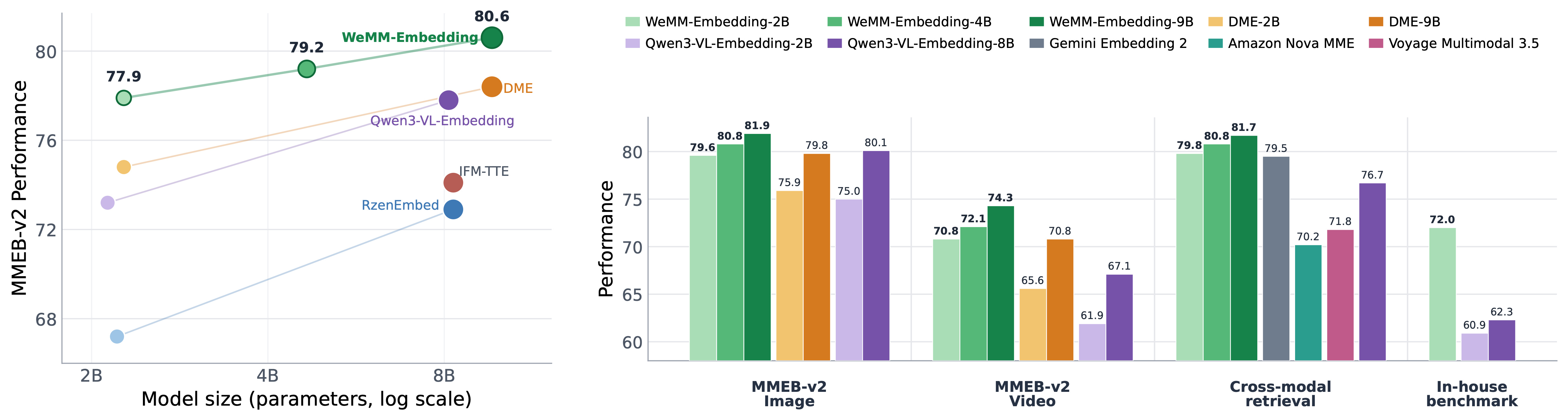
WeMM-Embedding is a family of universal multimodal embedding models developed by the WeChat Vision team. It provides unified representations for text, images, videos, visual documents, and interleaved multimodal inputs, achieving state-of-the-art performance across multiple benchmarks covering diverse tasks and domains.
| Model | Matryoshka dimensions | Hugging Face |
|---|---|---|
| WeMM-Embedding-2B | 64, 128, 256, 512, 1024, 2048 |
🤗 Link |
| WeMM-Embedding-4B | 64, 128, 256, 512, 1024, 2560 |
🤗 Link |
| WeMM-Embedding-9B | 64, 128, 256, 512, 1024, 2048, 4096 |
🤗 Link |
All models support text, images, videos, visual documents, and interleaved multimodal inputs. Embeddings are obtained from the last-layer hidden state at the dedicated <embedding> token position, followed by L2 normalization. Audio input is not currently supported.
pip install -r requirements.txtThe snippet below is fully standalone: it does not use any code or files from this repository, and the image is loaded from a URL. Just install the dependencies, save the code as demo.py, and run python demo.py:
pip install torch transformers==5.2.0 "qwen-vl-utils==0.0.14"import torch
import torch.nn.functional as F
from qwen_vl_utils import process_vision_info
from transformers import AutoModel, AutoProcessor
MODEL_ID = "tencent/WeMM-Embedding-2B"
IMAGE_URL = "https://huggingface.co/datasets/huggingface/documentation-images/resolve/main/pipeline-cat-chonk.jpeg"
processor = AutoProcessor.from_pretrained(MODEL_ID, trust_remote_code=True)
model = AutoModel.from_pretrained(
MODEL_ID, trust_remote_code=True, dtype=torch.bfloat16, device_map="cuda"
)
model.eval()
def encode(content: list[dict]) -> torch.Tensor:
messages = [{"role": "user", "content": content}]
text = processor.apply_chat_template(
messages, tokenize=False, add_generation_prompt=False
)
images, videos, video_kwargs = process_vision_info(
messages,
image_patch_size=16,
return_video_kwargs=True,
return_video_metadata=True,
)
if videos is not None:
videos, video_metadata = zip(*videos)
videos, video_metadata = list(videos), list(video_metadata)
else:
video_metadata = None
inputs = processor(
text=text,
images=images,
videos=videos,
video_metadata=video_metadata,
return_tensors="pt",
**video_kwargs,
).to("cuda")
with torch.inference_mode():
return F.normalize(model.embedding(**inputs).float(), dim=-1)
image_embedding = encode([{"type": "image", "image": IMAGE_URL}])
texts = ["A chubby Pallas's cat walking in the snow.", "A dog is running on a beach."]
text_embeddings = torch.cat(
[encode([{"type": "text", "text": text}]) for text in texts]
)
print("image embedding shape:", tuple(image_embedding.shape)) # (1, 2048)
print(
"text-image similarities:",
(text_embeddings @ image_embedding.T).flatten().tolist(),
)The first text should have a higher similarity to the image than the second one.
We recommend using transformers==5.2.0 for inference and reproducibility, as newer versions may differ in preprocessing behavior.
python examples/transformers_inference.py \
  --model tencent/WeMM-Embedding-2B \
  --image /path/to/image.jpg \
  --video /path/to/video.mp4 \
  --dimension 2048
The example produces independent text, image, and video embeddings. Omit --dimension for the full embedding dimension.
python examples/sentence_transformers_inference.py \
  --model tencent/WeMM-Embedding-2B \
  --image /path/to/image.jpg \
  --video /path/to/video.mp4 \
  --dimension 2048
SentenceTransformer loads the model directly, so a Hugging Face model id such as tencent/WeMM-Embedding-2B also works in place of a local path. Text, image, and video inputs go through SentenceTransformer.encode(), and MRL is selected with --dimension.
Tested versions: vLLM 0.27.0 and SGLang 0.5.9.
vLLM:
MODEL_PATH=tencent/WeMM-Embedding-2B
CHAT_TEMPLATE=$(hf download "$MODEL_PATH" embedding_chat_template.jinja)
vllm serve "$MODEL_PATH" \
  --runner pooling \
  --chat-template "$CHAT_TEMPLATE"
SGLang:
MODEL_PATH=tencent/WeMM-Embedding-2B
python scripts/patch_sglang_video.py
python -m sglang.launch_server \
  --model-path "$MODEL_PATH" \
  --is-embedding \
  --enable-precise-embedding-interpolation
Equivalent one-command wrappers are available in scripts/serve_vllm.sh and scripts/serve_sglang.sh.
For a supported dimension d, truncate the full embedding and normalize it again:
embedding = torch.nn.functional.normalize(embedding[..., :d], dim=-1)On MMEB-v2, the 2B model at 256 dimensions retains 98.7% of its full-dimensional image and video performance.
Results on 78 datasets from Table 1 of the technical report. Image and video tasks use Hit@1, while visual-document tasks use NDCG@5. Higher is better.
| Model | Size | AVG | Image | Video | VisDoc |
|---|---|---|---|---|---|
| VLM2Vec | 2B | 47.8 | 59.7 | 29.0 | 44.0 |
| GME | 2B | 55.4 | 51.9 | 33.9 | 76.8 |
| VLM2Vec-V2 | 2B | 59.3 | 64.9 | 34.9 | 69.2 |
| Qwen3-VL-Embedding | 2B | 73.2 | 75.0 | 61.9 | 79.2 |
| DME-Small† | 2B | 74.8 | 75.9 | 65.6 | 79.9 |
| WeMM-Embedding | 2B | 77.9 | 79.6 | 70.8 | 80.7 |
| WeMM-Embedding | 4B | 79.2 | 80.8 | 72.1 | 82.0 |
| VLM2Vec | 8B | 53.2 | 65.5 | 34.0 | 49.1 |
| GME | 8B | 59.2 | 56.0 | 38.6 | 79.3 |
| Qwen3-VL-Embedding | 8B | 77.8 | 80.1 | 67.1 | 82.4 |
| DME-Medium† | 9B | 78.4 | 79.8 | 70.8 | 82.0 |
| WeMM-Embedding | 9B | 80.6 | 81.9 | 74.3 | 83.3 |
† Closed-source leaderboard submission without publicly released model weights or a public inference endpoint.
Results on all 190 tasks; see the technical report for benchmark details. V3-All includes the 78 MMEB-v2 tasks, 53 text tasks, 47 agent tasks, 11 audio tasks, and MCMR. Unsupported tasks are assigned a score of zero.
| Model | Size | V3-All | Text | Agent | MCMR | Audio |
|---|---|---|---|---|---|---|
| VLM2Vec-V2 | 2B | 38.3 | 24.5 | 28.7 | 4.1 | 0.0 |
| Omni-Embed-Nemotron | 3B | 43.5 | 39.2 | 36.5 | 26.1 | 36.5 |
| E5-Omni | 3B | 44.6 | 26.7 | 36.9 | 31.9 | 30.8 |
| Qwen3-VL-Embedding | 2B | 50.9 | 39.2 | 39.3 | 42.0 | 0.0 |
| WeMM-Embedding | 2B | 55.8 | 45.3 | 44.1 | 42.5 | 0.0 |
| WeMM-Embedding | 4B | 58.0 | 47.9 | 48.1 | 41.9 | 0.0 |
| WAVE | 7B | 26.3 | 13.7 | 11.3 | 8.9 | 31.8 |
| VLM2Vec | 8B | 32.9 | 22.2 | 19.7 | 0.9 | 0.0 |
| LCO-Embedding-Omni | 7B | 40.6 | 32.4 | 27.8 | 20.0 | 43.2 |
| GME | 8B | 43.6 | 37.1 | 35.6 | 27.3 | 0.0 |
| E5-Omni | 7B | 47.1 | 26.9 | 36.7 | 41.1 | 43.0 |
| Tianmu-Emb-Uni | 8B | 53.3 | 43.6 | 39.4 | 38.8 | 38.9 |
| Qwen3-VL-Embedding | 8B | 53.5 | 42.5 | 38.4 | 38.0 | 0.0 |
| WeMM-Embedding | 9B | 59.3 | 48.8 | 50.1 | 49.3 | 0.0 |
Text results use NDCG@5; agent, MCMR, and audio results use Hit@1.
PeerQA and DeepPlanning scores and affected aggregates were updated on 2026-09-16 using task-wide global retrieval (#9).
mmeb_v3_eval/ contains the MMEB-v3 evaluation code used to produce our reported numbers. It is the official TIGER-AI-Lab/VLM2Vec pipeline with a minimal diff: multi-node multi-GPU inference (torchrun --nnodes=N), a wemm_embedding backbone implementing our preprocessing and batched inference, dataset instructions aligned with the released model, and 64-frame video sampling. Data download, single-node and multi-node commands are documented in mmeb_v3_eval/README.md.
cd mmeb_v3_eval
DATA_ROOT=/path/to/MMEB-V3 bash scripts/download_data.sh
MODEL_PATH=tencent/WeMM-Embedding-2B DATA_BASEDIR=/path/to/MMEB-V3 \
OUTPUT_DIR=exps/wemm_embedding bash scripts/run_eval.shIf you find this repository useful, please consider giving a star ⭐ and citation
@article{wemm-embedding,
      title={WeMM-Embedding: WeChat Multi-Modal Embedding Technical Report},
      author={Junjie Zhou and Ke Mei and Lei Li and Tianyi Wang and Fengyun Rao and Jing Lyu},
      year={2026},
      eprint={2608.24053},
      archivePrefix={arXiv},
      primaryClass={cs.CV},
      url={https://arxiv.org/abs/2608.24053},
}Unless otherwise noted, Tencent-authored code in this repository is released under the Apache License 2.0.
Third-party components retain their original licenses and copyright notices. Please review the corresponding source files before use.