





LongBanana has been accepted to NeurIPS 2026.
90 tasks per release · 9 categories · 32 reference images per task · graph-grounded evaluation
LongBanana evaluates whether image-generation systems can retrieve dispersed visual evidence, reject distractors, bind entities and relations correctly, and compose one coherent final image from many references. It measures reference-grounded correctness beyond visual plausibility or a single holistic quality score.
This repository provides LongBanana-Gen and LongBanana-Eval with sandboxed OpenClaw, Codex, and Claude Code integrations, optional visual-specialist judging, and a direct Gemini VLM judging baseline. Planning and judging models are independently configurable using Gemini, GPT, or Claude. Image generation uses Gemini 3.1 Flash Image.

Each task pairs a synthesis instruction and a heterogeneous reference inventory with a graph-grounded checklist. The entity–relation graph connects required content, local bindings, relations, and scene-wide constraints to atomic, visually verifiable evaluation items.
| Suite | Category | Capability | Tasks per release |
|---|---|---|---|
| Scene Composition | SCC | Semantic Coverage & Consistency | 10 |
| Scene Composition | RGC | Relational Graph Consistency | 10 |
| Scene Composition | LAC | Layout Arrangement Consistency | 10 |
| Visual Appearance | GAC | Global Appearance Conditioning | 10 |
| Visual Appearance | LAB | Local Appearance Binding | 10 |
| Visual Appearance | AHC | Appearance Harmonization & Coherence | 10 |
| Reference Reasoning | SEL | Selection & Retrieval | 10 |
| Reference Reasoning | TSR | Temporal / State Reasoning | 10 |
| Reference Reasoning | AGG | Counting & Aggregation | 10 |
The taxonomy describes each task's dominant demand. The three grading dimensions used across tasks are Content Fidelity, Relational Binding, and Global Constraint Satisfaction.

LongBanana-Gen lets an agent inspect references, plan, call the image backend, and revise intermediate outputs. The OpenClaw RPR workflow combines ReAct, Plan–Exec, and Reflect. Codex and Claude Code use their native tools and image viewing with a shared generation prompt and Gemini MCP interface. Backend guidance is available for optional reading. Agents decide how many generation or editing calls to make within the configured execution timeout.
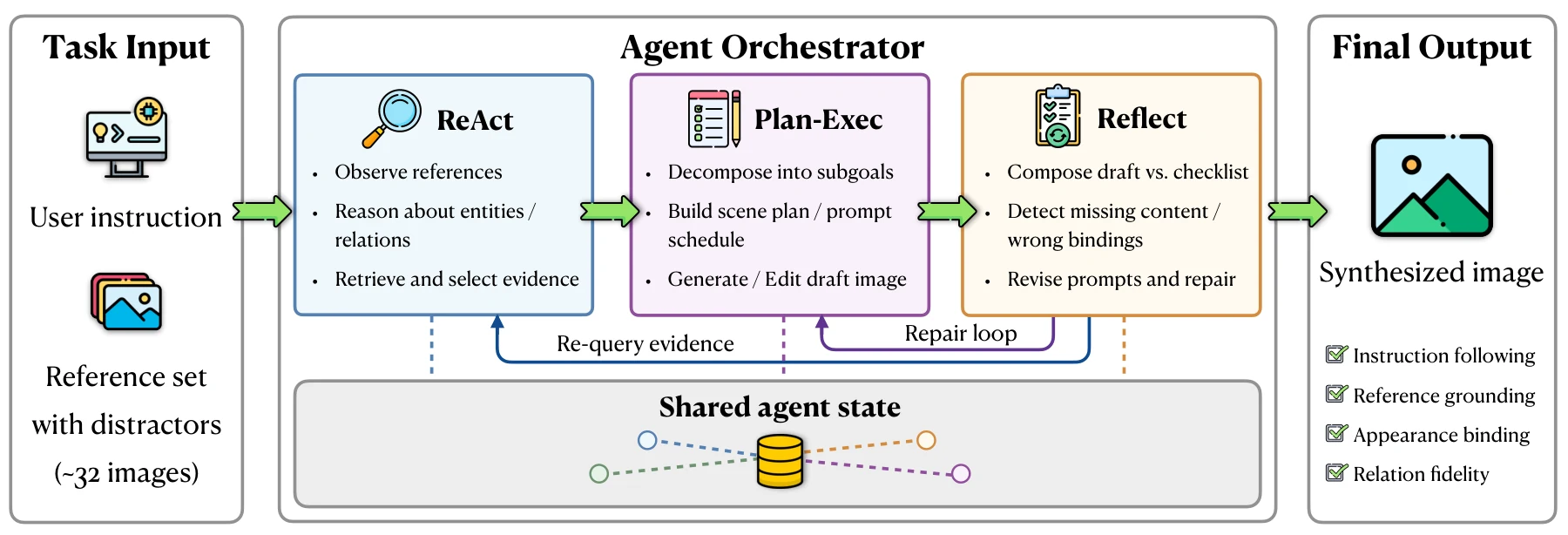
LongBanana-Eval judges individual checklist obligations against a generated candidate and the references bound to that check. Bindings come from the dataset, not an agent's retrieval decision. An agent may decide which supplied references to open. OpenClaw optionally delegates evidence gathering to OCR, detection/counting, layout, and identity specialists.
| Supported execution mode |
|---|
| Direct VLM (Gemini) |
| OpenClaw |
| Codex |
| Claude Code |
Agent tasks run in Linux Bubblewrap sandboxes with read-only inputs and isolated workspaces. Generation agents cannot access evaluation checklists, simulated targets, or prior scores. Upstream credentials remain in the supervisor. Networking is shared: Bubblewrap isolation is not a network-domain allowlist. See architecture for execution and access boundaries.
Labels use Fail = 0, Uncertain = 1, and Pass = 2:
Case score = 100 × sum(item scores) / (2 × number of items)
Category score = mean(case scores in the category)
Overall score = mean(all case scores)
These are unweighted case-mean scores. Invalid responses have no numeric score; incomplete runs report coverage and provisional scores. Report the dataset release, Judge configuration, and any missing-value policy alongside results. Difficulty- weighted scores require an identified weight file and evaluation cohort. Historical paper results use their stated aggregation and must not be relabelled as results for another dataset release or execution profile.
Download the datasets from Hugging Face. Dataset archives are distributed separately from code.
| Release | Cases | References | Evaluation checks |
|---|---|---|---|
open_v1 |
90 | 2,880 | 4,670 |
open_v1p5 |
90 | 2,880 | 5,170 |
open_v1p5 extends open_v1 with 90 additional tasks featuring non-overlapping
content. Both releases share the same data format, task taxonomy, and generation
and evaluation workflows, allowing users to expand their experiments with the
same pipeline. Select a release with DATASET_MANIFEST.
Use Linux, Python 3.11+, Node.js, and Bubblewrap, plus a supported agent runtime.
The fixed OpenClaw build is included in openclaw-runtime/; Codex and Claude Code
are obtained separately. See the runtime guide for dependency
setup and pinned versions. No private repository is required.
The main branch contains the sandboxed implementation.
git clone https://github.com/TIGER-AI-Lab/LongBanana.git
cd LongBanana
python -m pip install -e .
npm ci --prefix mcp/image_gen
Existing Python and MCP dependencies may be reused instead of installed. No run automatically installs an agent runtime or changes the environment. Switching a code branch does not select or convert a dataset.
Copy an example configuration and supply local paths through environment variables:
export DATASET_MANIFEST=/path/to/open_v1/manifest.json
export RUNTIME_MANIFEST=/path/to/runtimes.json
export BWRAP_PATH=/path/to/bwrap
export MCP_MODULES="$PWD/mcp/image_gen/node_modules"| Configuration | Default model interface | Credentials |
|---|---|---|
| Codex | OpenAI Responses | OPENAI_API_KEY, OPENAI_MODEL |
| Claude Code | Anthropic Messages | ANTHROPIC_API_KEY, ANTHROPIC_MODEL |
| Gemini model fragment | Google Gemini, with explicit protocol conversion | GEMINI_API_KEY, GEMINI_MODEL |
| OpenClaw | Configurable provider interface | See the example and runtime guide |
| Direct Gemini VLM | Google Gemini | GEMINI_API_KEY, GEMINI_MODEL |
Generation also requires GEMINI_API_KEY for gemini-3.1-flash-image. Examples
target official provider endpoints; select model IDs available to your account.
Keep credentials in environment variables and do not commit local configurations.
See running experiments for the runtime manifest, OpenClaw
settings, concurrency, and timeout options.
Validate the dataset, then inspect a single case or run the full release:
python -m longbanana validate-data "$DATASET_MANIFEST" --evaluation
python -m longbanana generate --config examples/codex.json --output runs/gen --case LAC-001 --dry-run
python -m longbanana generate --config examples/codex.json --output runs/gen --resume
Use examples/claude-code.json or examples/openclaw.json for another agent.
--dry-run checks inputs and runtime paths without API calls. Accepted outputs are
listed in runs/gen/candidates.json. Resume reuses valid outputs only when input,
configuration, code, runtime, and output fingerprints match.
Generation and judging can use different model configurations. Evaluate the same candidate manifest with an agentic Judge and the direct baseline:
python -m longbanana judge --config examples/codex.json --candidates runs/gen/candidates.json --output runs/judge --resume
python -m longbanana judge-direct --config examples/direct-vlm.json --candidates runs/gen/candidates.json --output runs/direct --resume
Choose another agent configuration to change the Judge. OpenClaw's subagents
setting enables or disables visual specialists. Outputs include experiment.json,
per-task records in results/, attempts, and summary.json. Keep a separate output
directory for each configuration. See reproducibility.
src/longbanana/           Unified CLI, sandbox, transports, generation and judging
src/openclaw_longbanana/  Retained OpenClaw generation and Judge workflows
mcp/image_gen/           Gemini image-generation MCP server
openclaw_skills/         Visual Judge specialist instructions
examples/                Official-provider configuration examples
docs/                    Architecture, dataset format and execution guides
tests/                   Offline tests
Run offline tests with python -m unittest discover -s tests -v.
Release packaging documents the source/data separation.
| Haoxiang Cao | Yuxuan Zhang |
| Kelsey R. Allen |
LongBanana builds on the OpenClaw, Codex, Claude Code, Bubblewrap, and Model Context Protocol ecosystems. Code and accompanying documentation are licensed under MIT. Retained third-party notices are in NOTICE.router and NOTICE.openclaw; separately installed runtimes retain their own licenses. Artwork sources identify the project figures and third-party brand marks.
The open_v1 and open_v1p5 datasets are licensed separately under
CC BY 4.0. Each archive includes the
full license and attribution information.
Paper: arXiv:2611.06856. Visit the Project Page for the research overview. Please cite LongBanana when using the benchmark:
@inproceedings{cao2026longbanana,
  title={LongBanana: An Expert-Verified Benchmark for Long-Context Multi-Reference Image Synthesis},
  author={Cao, Haoxiang and
          Zhang, Yuxuan and
          Du, Penghui and
          Li, Bo and
          Cao, Jiajiong and
          Fan, Yingying and
          Wu, Zimeng and
          Luo, Yifu and
          Zheng, Mingzhe and
          Miao, Junwen and
          Zhang, Huaisong and
          Yao, Yang and
          Wang, Yu and
          Jiang, Dongfu and
          Nie, Ping and
          Chen, Wenhu and
          Wang, Chaoqun and
          Yu, Changqian and
          Allen, Kelsey R.},
  booktitle={Advances in Neural Information Processing Systems (NeurIPS)},
  year={2026},
  eprint={2611.06856},
  archivePrefix={arXiv},
  primaryClass={cs.CV},
  url={https://arxiv.org/abs/2611.06856}
}