



reid turns a person crop into an appearance embedding, a vector that is close for crops of the same person and far apart for different people. It loads pretrained OSNet and FastReID checkpoints, embeds supervision.Detections from any detector or crops saved on disk, and measures how well a model matches people: across cameras with retrieval on Market-1501 and MSMT17, or over time with re-association on crops cut from MOT-format video. Requires Python 3.10 or newer.
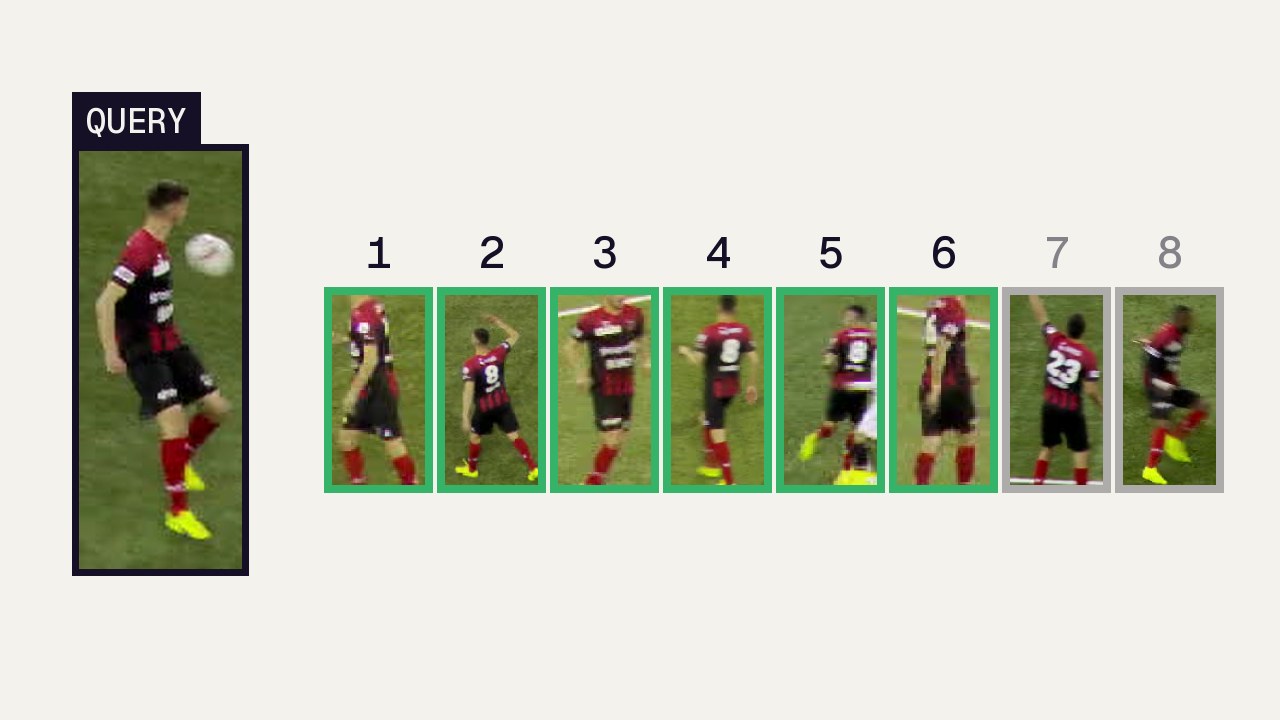
reid_gallery_demo_branded_crf24.mp4
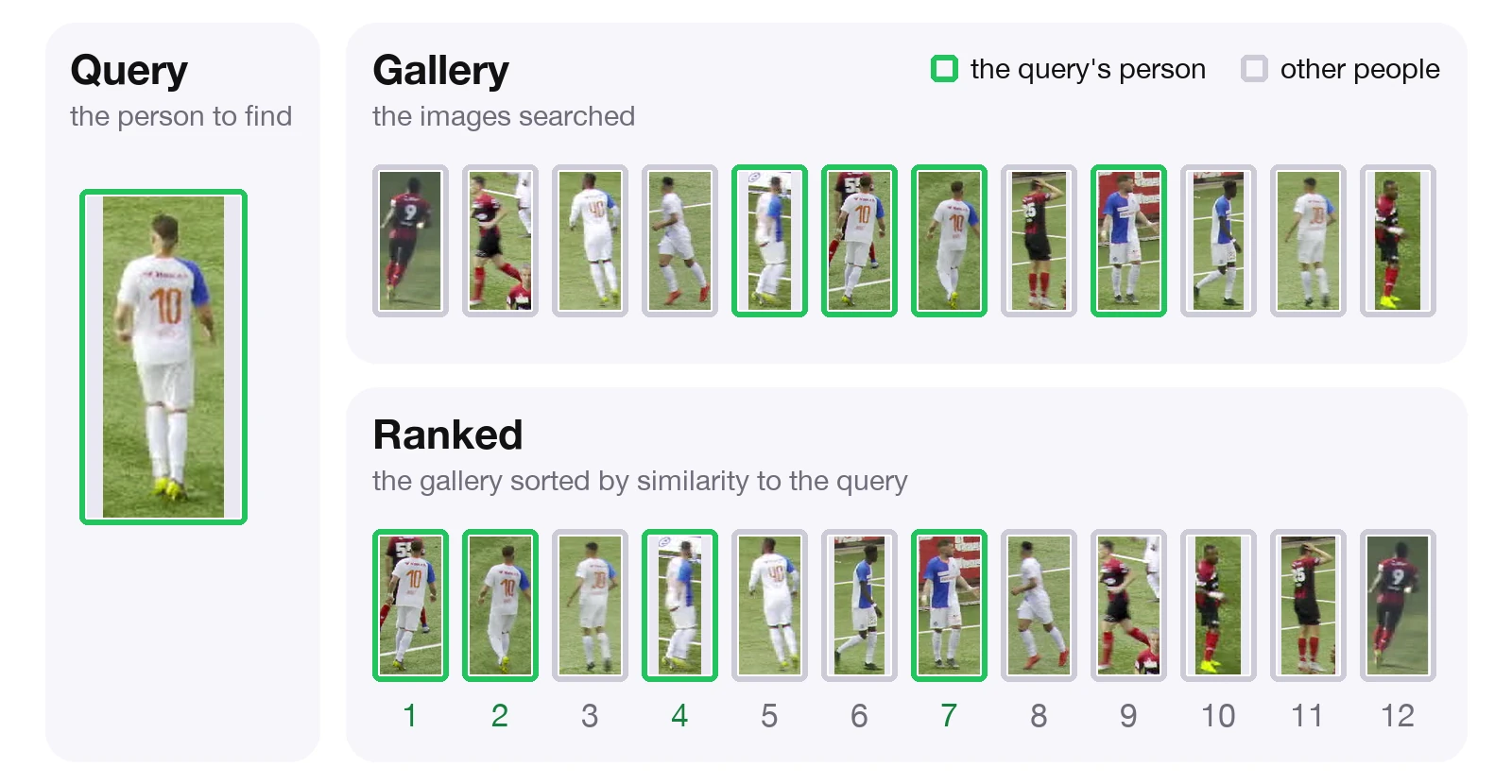
Gallery retrieval with osnet_x1_0_msmt17_combineall: crops ranked by cosine distance to a query player, closest first. The other pretrained models work the same way.
Read the documentation for guides and the API reference.
pip install -U reidInstall from source
pip install git+https://github.com/roboflow/re-ID.gitFor development, clone the repository and run uv sync --all-extras or pip install -e ".[dev]".
extract_embeddings computes one embedding for each bounding box in a frame. Pass the boxes as sv.Detections, which you can get from a detector like RF-DETR. Below, two people are boxed in the first frame of a sample video. from_pretrained downloads the model you name, here OSNet x1.0 trained on MSMT17.
import numpy as np
import supervision as sv
from supervision.assets import VideoAssets, download_assets
from reid import ReIDModel

model = ReIDModel.from_pretrained("osnet_x1_0_msmt17_combineall")

frame = next(sv.get_video_frames_generator(download_assets(VideoAssets.PEOPLE_WALKING)))
detections = sv.Detections(xyxy=np.array([[746, 446, 828, 628], [1136, 502, 1214, 660]], dtype=np.float32))
embeddings = model.extract_embeddings(detections, frame)

embeddings.shape
# (2, 512)
Crops already saved as images work the same way:
embeddings = model.extract_embeddings_from_paths(["crop_1.jpg", "crop_2.jpg"])For every way to load a model, including saved models, Hugging Face repositories, and weights files, see the loading guide.
There are two ways to build a model: ReIDModel.from_pretrained("osnet_x1_0_msmt17_combineall") loads trained weights, and ReIDModel("osnet_x1_0") builds the architecture with random weights.
model.evaluate scores a model on benchmark splits or on your own identity folders, one folder of crops per person.
from reid import ReIDModel, load_identity_folders, load_market1501

model = ReIDModel.from_pretrained("osnet_x1_0_msmt17_combineall")

query, gallery = load_market1501("/path/to/Market-1501")
result = model.evaluate(query, gallery)

result = model.evaluate(load_identity_folders("/path/to/identity/folders"))
result.metrics
# {'map': ..., 'rank1': ..., 'rank5': ..., 'rank10': ..., 'minp': ...}
For crops cut from video, ReassociationProtocol asks whether the model recognizes a person a set number of frames later, the way a tracker uses it. See the evaluation guide and the metric definitions.
| Name | Architecture | Trained on | Use for |
|---|---|---|---|
osnet_x1_0_msmt17_combineall |
OSNet x1.0 | MSMT17, all splits combined | General pedestrian embeddings. Not for evaluating on MSMT17, whose test identities it has seen. |
fastreid_mot17_sbs50 |
FastReID SBS, ResNeSt-50 | MOT17 train-half ground-truth crops | MOT17 tracking, as in BoT-SORT |
osnet_x1_0_mot17 |
OSNet x1.0 | MOT17 train-half crops | Tracking pedestrians, as in MOT17 |
osnet_x1_0_sportsmot |
OSNet x1.0 | SportsMOT train crops | Tracking basketball, football and volleyball players, as in SportsMOT |
osnet_x1_0_dancetrack |
OSNet x1.0 | DanceTrack train crops | Tracking dancers in similar outfits, as in DanceTrack |
osnet_x1_0_soccernet |
OSNet x1.0 | SoccerNet train crops | Tracking soccer players, as in SoccerNet |
list_aliases() lists these names. Any timm:<name> backbone and other OSNet sizes load from a weights file; see the loading guide.
 How to Use Re-ID
Load a model, match the boxes of a MOT17 frame to a later frame with distance_matrix, see identities cluster, and evaluate with retrieval and re-association.

 How to Benchmark Re-ID Models
Evaluate OSNet x1.0 on Market-1501 and MSMT17 and compare against the torchreid model zoo.
| Guide | What you will do |
|---|---|
| Load a model | Load pretrained names, saved models, Hugging Face repositories, and weights files, and set image preprocessing |
| Evaluate a model | Score a model on Market-1501, your own identity folders, or crops cut from video |
| Understand the metrics | Read mAP, rank-k, mINP, and MRR, and see why tracking needs re-association |
If you use reid in academic work, please cite the library:
BibTeX
@software{roboflow_reid,
  author  = {{Roboflow}},
  title   = {Roboflow Re-ID},
  url     = {https://github.com/roboflow/re-ID},
  year    = {2026},
  license = {Apache-2.0}
}
For the models themselves, cite OSNet (Zhou et al., ICCV 2019) and FastReID (He et al., 2020).
The code is released under the Apache 2.0 license.